Buying a home in Singapore is, mechanically, easy. You pick an area you like, you find a unit you can afford, you sign. The hard part is the one almost nobody answers before they commit: of every condo in that area, do you actually know which one is the strongest performer?
Choosing the area is the easy 80%
Everyone can read a map. You already know the good districts, the MRT lines, the schools, the new masterplan that’s “coming up”. So does every other buyer, which means none of it is an edge. By the time an area is obviously good, the market has already priced it in. The neighbourhood gets you in the door. What you walk out with depends on the specific project.
The question that actually decides your money
Within a single good area, projects diverge enormously. When I run the URA resale data through BuySafe, the weakest projects in a region, the ones with enough transactions to read, have gained only a fraction of what the region averaged over the same hold. Same area, same window, and a spread of twenty points or more between the project that compounded and the one that merely sat there. The difference was the project itself, not the address.
You’re not really choosing an area. You’re choosing one project, one stack, one unit, and that single choice is where the gain is won or lost.
Why you can’t see this from a listing portal
A property portal shows you what’s for sale and what sellers are asking. It does not show you the thing that matters: how each project has actually held its value, like-for-like, once you strip out the noise.
- Headline averages lie by accident. If larger or higher-floor units happened to sell recently, a project’s “appreciation” drifts upward, and a flat performer can look like a strong one. Same data, very different story.
- Liquidity is invisible until you sell. A project that trades a handful of units a year has no price discovery. The portal won’t tell you the exit is thin. You find out when you’re the one trying to leave.
- The right unit isn’t the right project. A project’s 2-bedders can perform completely differently from its 4-bedders. The headline figure blends them; your actual purchase doesn’t.
What we bring to the table
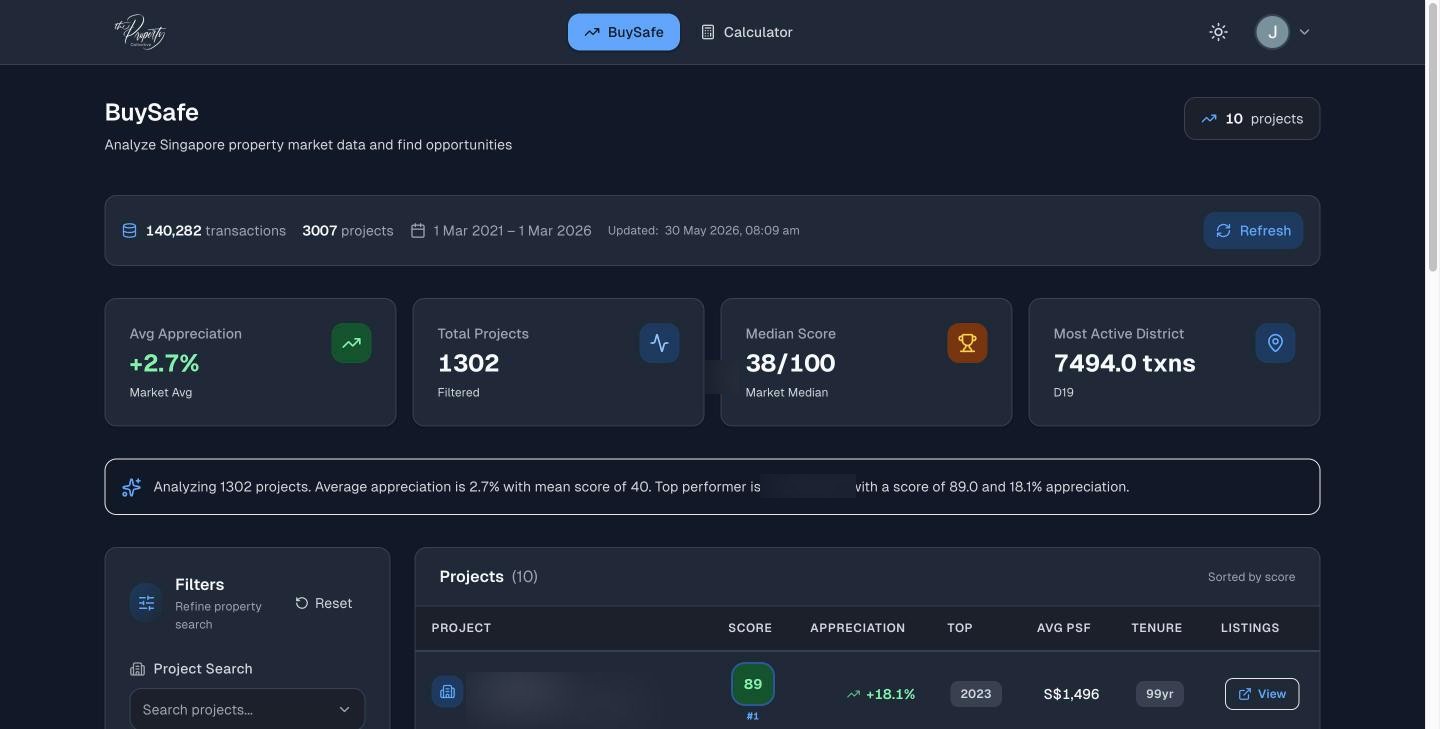
This is the gap our own analysis engine, BuySafe, was built to close. It draws on 140,000+ publicly available URA transactions across 3,000+ private condo projects and uses a hedonic regression, the same family of methods used to build official house-price indices, to estimate true, like-for-like price growth, adjusted for unit size, floor and time.
Every project then carries a single comparable score from 0 to 100, weighing estimated appreciation, how easily you could exit, value against the market, recent momentum and price stability. Where the data is too thin to trust, it shows nothing rather than a confident guess. So instead of debating whether an area is “good”, we can point to the specific projects in it that have a safe, liquid exit, and the ones priced on reputation alone.
But the score is the start of the conversation, not the end of it. A number can’t know your timeline, your CPF position, whether you’re buying to hold or to progress in five years. That read, turning the data into the right move for your situation, is the part you’re really hiring us for.
You don’t get access to a dashboard. You get the answer: which project, which stack, which unit is the strongest performer where you want to buy, walked through with you, against your own shortlist.
BuySafe isn’t something you log into. It’s what we walk you through, on your shortlist, in a consultation.
Not financial advice. This analysis is based on historical, publicly available transaction data for informational purposes only. It is not financial, investment, legal or tax advice, and not a recommendation to buy, sell or hold any property. Past performance is not indicative of future results.
Estimates, not guarantees. Scores and appreciation figures are model-based estimates and may contain errors or omissions. Always conduct your own due diligence.
Independent. The Property Collective is not affiliated with, endorsed by, or connected to the Urban Redevelopment Authority (URA). Transaction data is sourced from publicly available URA records.